WORLD & GAME GUIDE · VERSION 0.6
Lightseeker
A mobile-first strategic roguelike auto-battler.
- Updated
- 11 October 2026
- For
- Players and world explorers
- Journey
- Playable build · growing world
01 · THE PROMISE
Find the light.
Keep the route alive.
Lightseeker is a mobile-first strategic roguelike auto-battler. A crew crosses a cold, fragmented archipelago, and each expedition combines formation building, readable automatic combat, roguelike upgrades and consequential route choices.
Every voyage should leave you with a story: the traveler who held the line, the risky upgrade that changed the crew, or the route you chose when the safe harbor was one turn away.
02 · WORLD
The White Tide archipelago
The old lighthouse chain once made trade, rescue and memory possible between the islands. Then the lights failed. Sea roads vanished into fog, communities became isolated, and the origin of the darkness passed into rumor.
The player leads a crew following traces of the First Light. Relighting a beacon does more than clear a level: it reveals another route and another piece of the archipelago’s history.
Every lighthouse remembers the route to another.
03 · GAME LOOP
A compact expedition with layered decisions
Build the deck
Choose up to six travelers. Roles, positions, equipment and the equipped lantern define the starting plan.
Auto-battle
The encounter resolves automatically, but the outcome reflects decisions made before and during the route.
Choose one of three
Select one upgrade. Reinforce the current build or pivot toward a new one.
Choose the route
Pick risk, recovery, reward or an uncertain signal. The expedition becomes a chain of authored choices.
New-player starting point: the starter pack grants three initial travelers. As the collection grows, a deck can contain up to six. Detailed balance remains subject to playtesting.
04 · PLAY ON MOBILE
A voyage built for the hand
Lightseeker uses a 9:20 portrait layout, large tap targets, short information paths and clear hierarchy. A voyage should be easy to resume after real life interrupts it, without reducing strategy to idle progression.
- Portrait-first interface rather than a wrapped web view.
- Core actions within one-thumb reach where practical.
- Your current state returns clearly after a reconnect.
- Android is the primary way to enter the archipelago.
05 · WALLET & IDENTITY
Your identity travels with you
A wallet appears only when it creates a clear benefit for the player. Ordinary combat stays fast and off-chain; connection, identity and rare verifiable moments are where Solana can matter.
Connect on Seeker
Mobile Wallet Adapter and Sign In With Solana work directly inside the Android journey.
Confirm a completed voyage
The final candidate asks the wallet to sign a completed D0 settlement before the authoritative service projects rewards.
Make SKR serve the game
The formal economy issues no project token. SKR is planned as its sole circulating token, subject to security, audit and applicable-rule validation.
Lightseeker has no live token sale or promised financial return. Ordinary play stays fast and off-chain; only meaningful outcomes ask for player confirmation.
06 · PLAY, REWARD & TRADE
Play creates rank.
Rank determines reward.
The core economy gives daily play, expedition performance and competition distinct destinations, while eligible drops can keep moving between players. Eligibility and settlement are verified by the authoritative service.
Daily bounty
Eligible boss clears generate bounty tickets for the next daily draw, giving even a short session a clear purpose.
PVE rewards
Season expedition performance and Tide Crystal balance form a PVE leaderboard. Server-confirmed final position determines the reward tier.
PVP rewards
Arena score forms a periodic ranking. Players can challenge real opponents or use available robot opponents to test a formation.
FORMAL ALLOCATION DESIGN · NOT LIVE
Each 100 SKR of primary system spend
PLAYER-PRICED TRADE
Choose what to list—and at what price
The marketplace provides listing and settlement infrastructure only; it does not set or influence prices. Sellers choose the asset, quantity and unit price, while buyers decide whether to trade. Materials may have minimum lot-size requirements—for example, groups of five—to avoid dust listings. That is a quantity threshold, never a price restriction.
The first release plans to make Tide Iron, Mist Leather and Star Sand from paid difficulties tradable while D0 drops remain bound; equipment, lanterns and materials share listing slots. Designed split: on each 100 SKR of secondary-market volume, the seller receives 95, while the team and burn each receive 2.5.
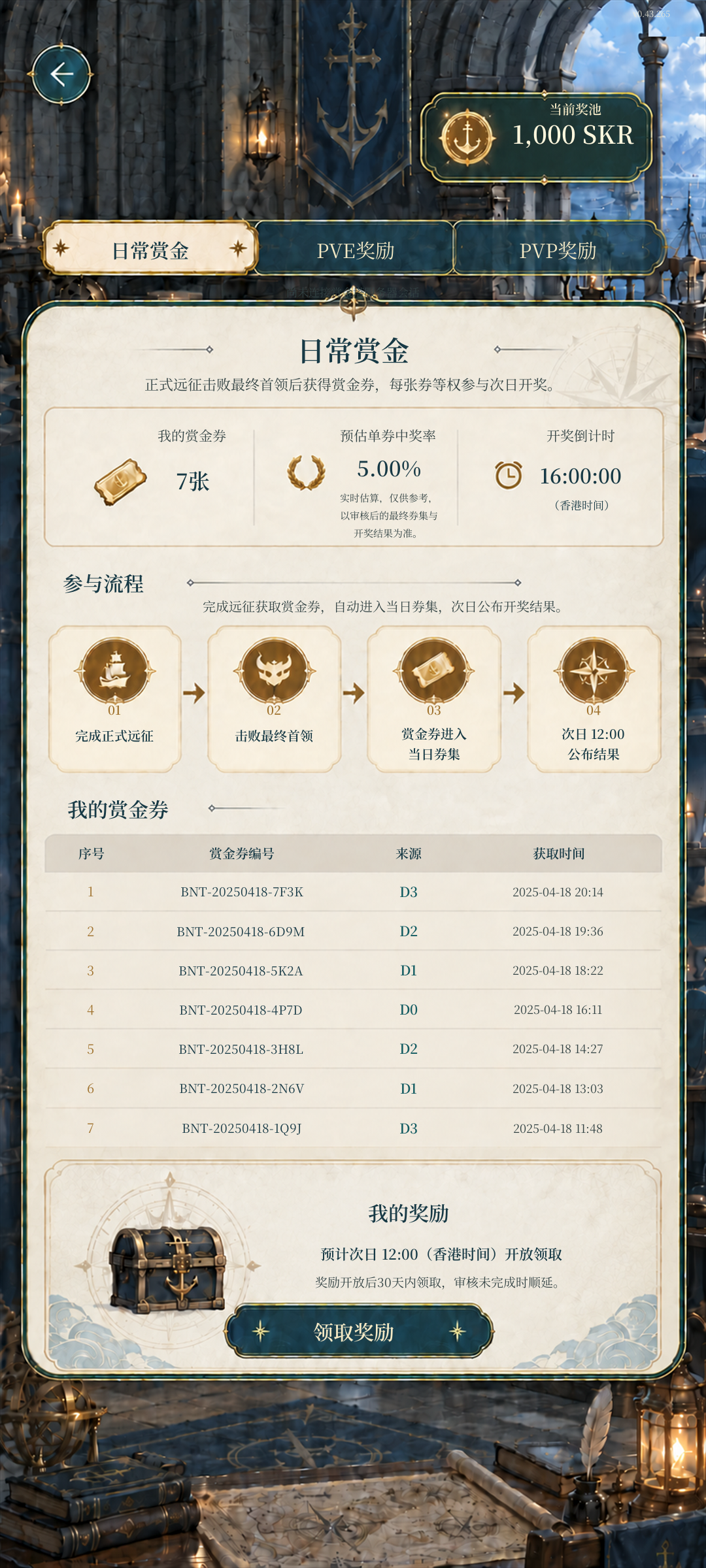
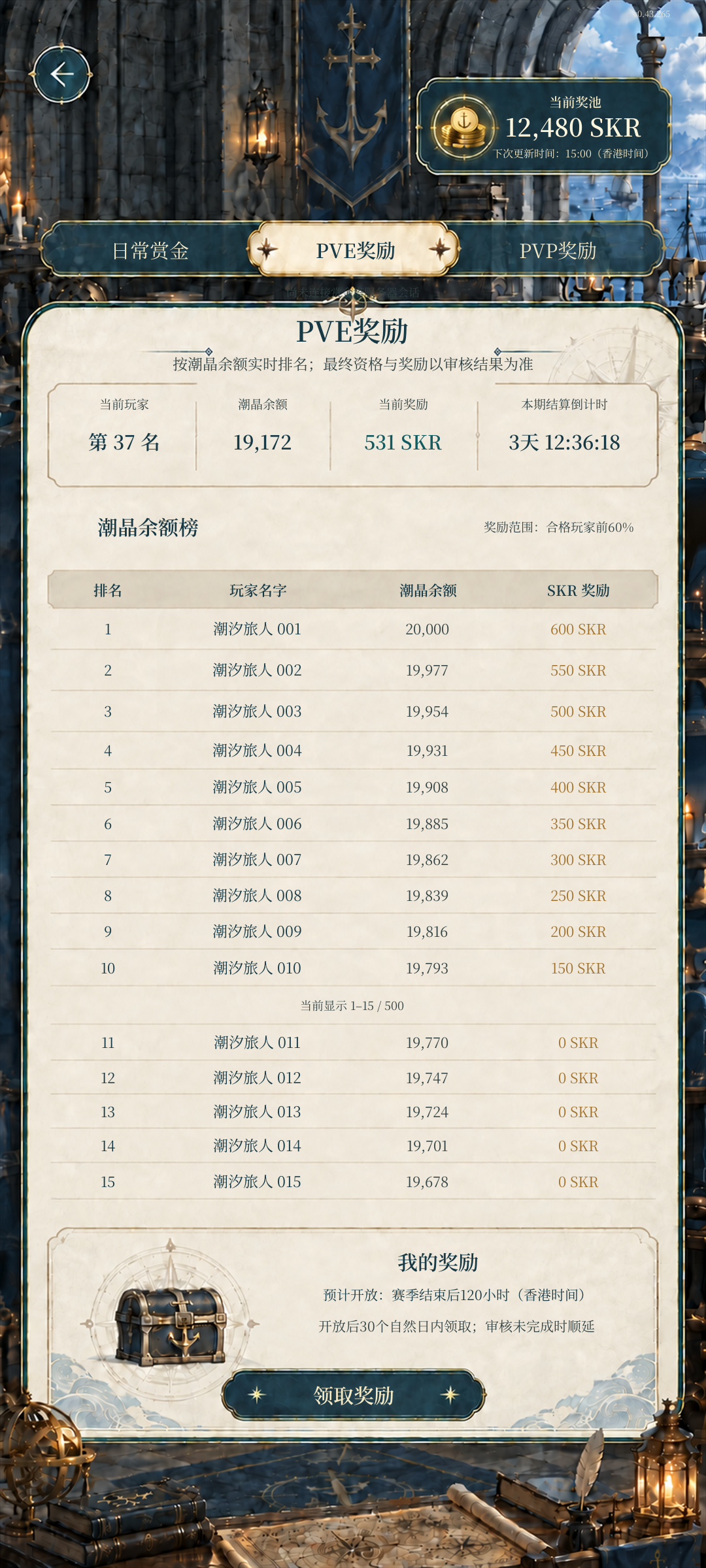
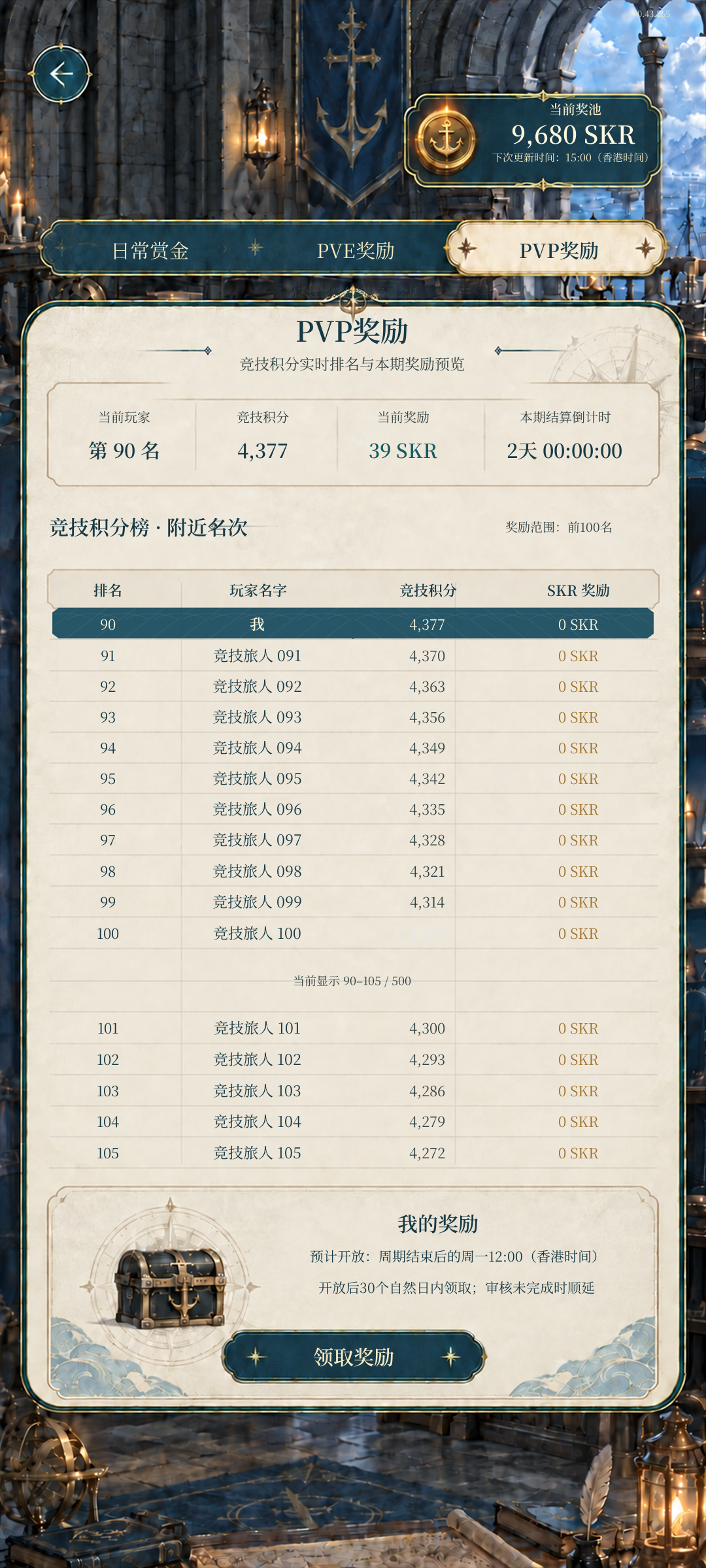
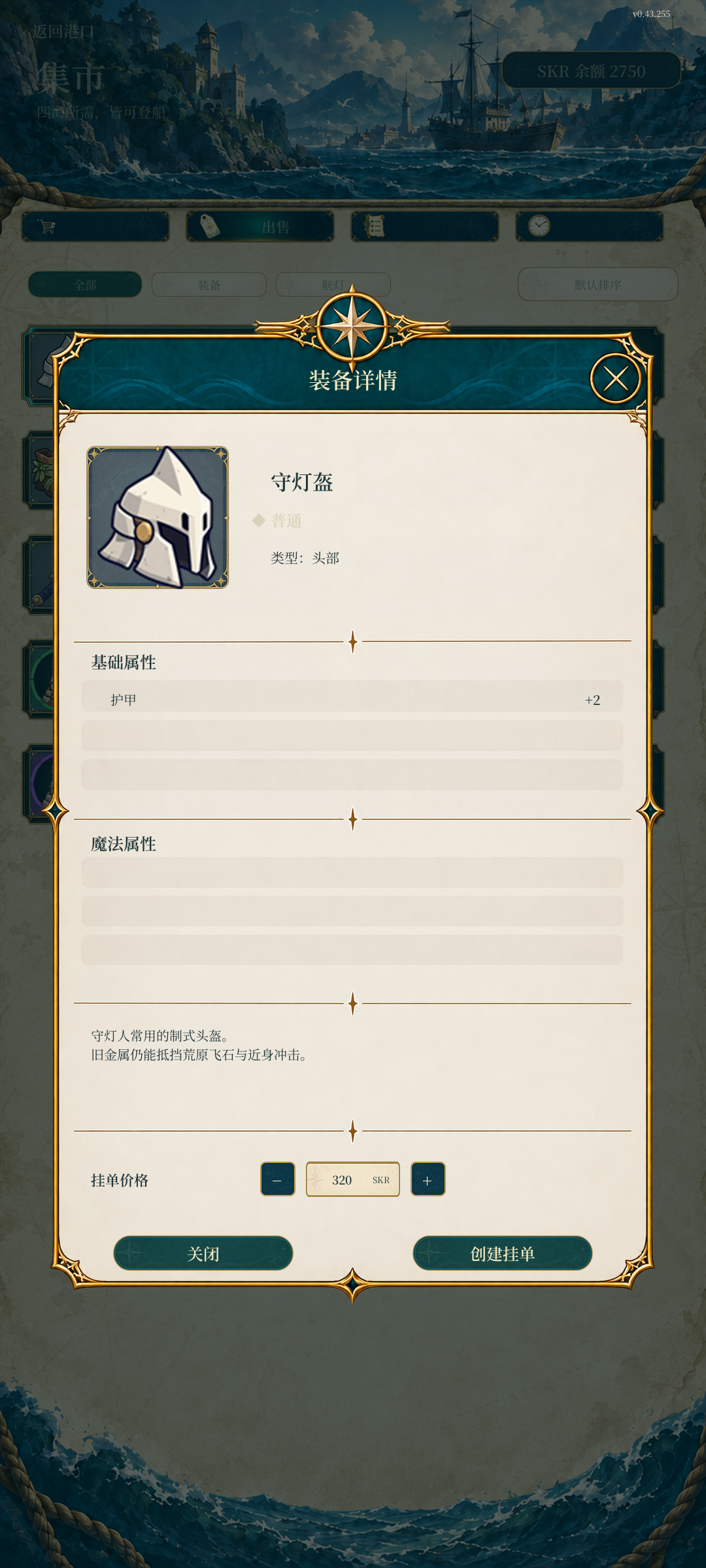
Current boundary: bounty, PVE/PVP ranking and market interfaces are present in the game build. The SKR pools, real rewards, player settlement and burn described here are formal economy design and are not publicly live. Test values visible in screenshots are not public reward commitments.
08 · CURRENT VOYAGE
What players can already see
Lightseeker is in active development. Screens and rules may evolve as playtesting reveals what makes each voyage more readable and rewarding.
09 · BEYOND THE FOG
What waits past the next lighthouse
- NOW
Close the first complete voyage
Complete D0 with its boss, visible rewards, signed settlement and authoritative inventory projection as one reliable journey.
- NEXT
dApp Store and Season 0
Run the public test while expanding heroes, builds, chapters, bosses, arena play and market content.
- LATER
Phase in real SKR functions
Enable spend, reward, trade and burn only after security, audit and applicable-rule validation.
10 · DEVELOPMENT NOTES
A living world, honestly described
Lightseeker is still being built. Screens on this site come from the working game, while rules, balance, content and names may change as the experience improves.
This page is a player-facing world and game guide, not the complete economic whitepaper. A separate formal whitepaper will document detailed play systems, setting, SKR sources and destinations, reward-pool and market boundaries, safeguards and version changes. Test values will not be presented as public commitments before parameter, compliance and mainnet security reviews are complete.
Experimental systems are labelled as such. A feature is never presented as publicly available merely because it appears on the horizon.